Maxan Interior Systems is improving sustainability through technology
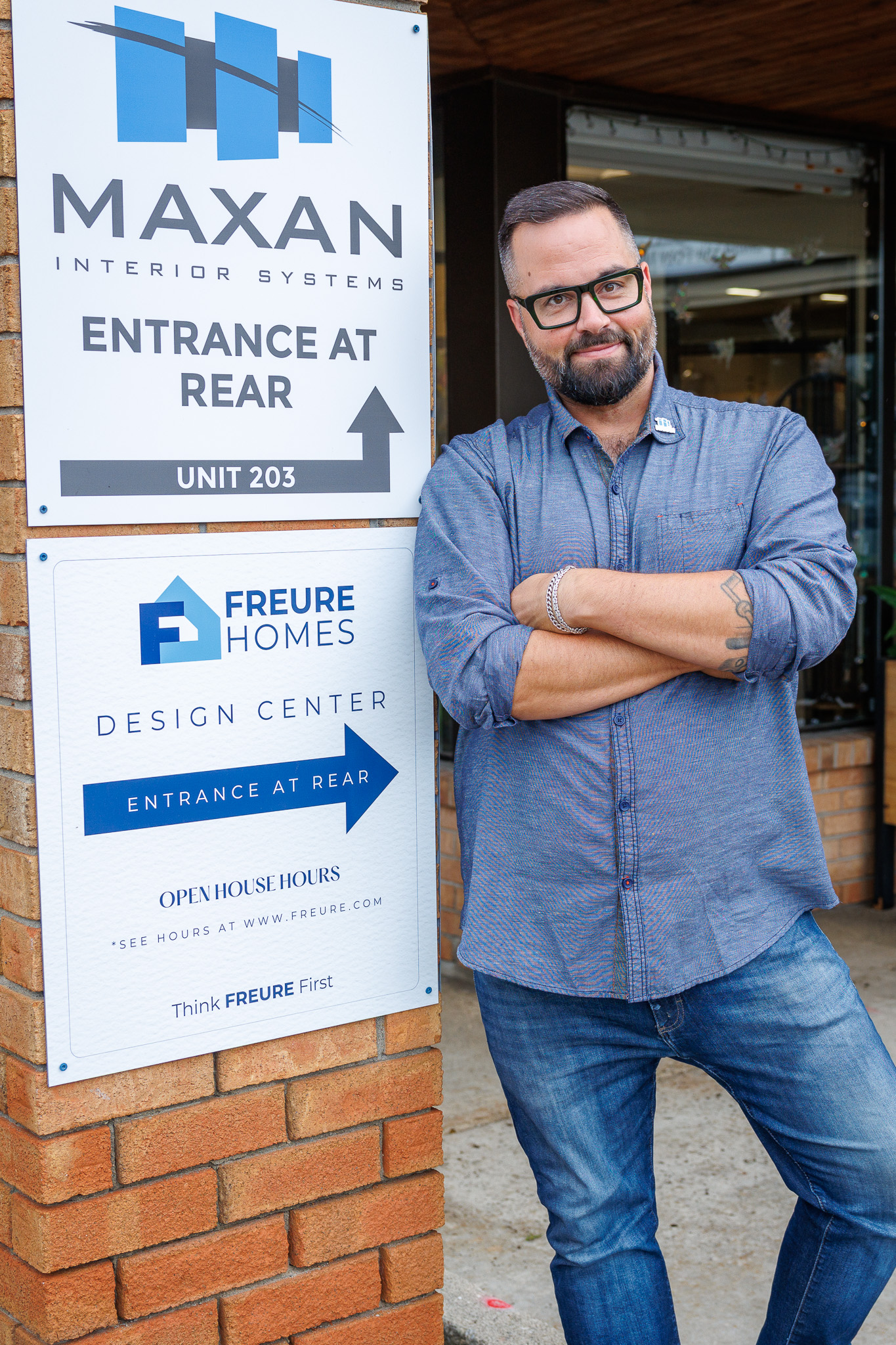
In construction, reputations are as important as a good foundation. That’s something Jacob Vander Zanden knows well. Throughout his 25-year career, Vander Zanden has worked with trades and construction companies across Canada and throughout North America. When he and his family relocated to Waterloo Region in 2025, he helped establish Maxan Interior Systems in Waterloo Region, permanently grounding the fast-growing interior solutions company for its new office in Kitchener as its branch manager.
“Before joining the Maxan team, I'd brought them in as strategic partners on some of my previous projects, and was always impressed with how they treated both the projects, and myself as a client,” Vander Zanden said. “At every level, that culture was visible — it's the kind of company you're proud to work with, and one I'm now proud to work for and help grow.”
Maxan Interior Systems opened its local office in the summer of 2025 and the team has quickly grown to continue supporting projects across Waterloo Region and southwestern Ontario.
“Maxan had previously been active in the Waterloo Region, and decided it was time to have local representation rooted in the community.”
Framing for success
Maxan Interior Systems was founded in 1990 and quickly built a reputation with its work in insurance, banking, and other client fit-up projects in downtown Toronto. In 2019, Vander Zanden said the company’s new ownership started looking to build their presence using new materials, adding colleagues with diverse experience in construction, and leveraging elite technology to expand the vision of what it could deliver for clients.
Today, Maxan Interior Systems handles a wide range of ICI drywall and acoustic scopes through both a production and dedicated service division, and also a recently launched architectural walls department specializing in demountable partitions and office front systems.
“We handle demising barriers, acoustic ceiling systems, custom baffling and louvered ceilings, security and partition walls with metal lath and plating for banks and tech companies, including educational and health institutions just to name a few pursuits. Steel stud drywall creates the core of our operations, but we can address just about anything that touches these wall and interior systems,” he said.
Materials and technology are one thing. People and teams are another. Vander Zanden said the company’s internal structure has evolved alongside the materials they work with.
“Where some subcontractors may only have one person wearing the project manager, estimator, and business development hats, we have split those roles into distinct but closely connected departments — similar to how general contractors often structure their own organizations. There's been a learning curve, but it's given us direction and stability to make real and remarkable progress,” he said.
One recent example that stands out to Vander Zanden was a two-tower project featuring custom exterior aluminum architectural panels connecting the two structures. When the base building contractor walked away because of the scope’s complexity, Maxan confidently stepped up. Each item needed to specifically complement the next, creating unique geometric patterns that wrapped around the building’s exterior and entryways.
“The manufacturer wanted to hang their panels directly on our framing and substrate, requiring constant scaling to correctly join these vertices over a shifting, 3-dimensional landscape of floating surfaces on fixed planes,” Vander Zanden said. “It took extensive pre-planning and leaning heavily into our use of digital technology to pull this together. In the end, every panel clipped into place within an eighth of an inch of the next — a huge credit to the project management team in the office and the crew on site who worked throughout both summer and winter environmental challenges.”
Taking a sustainable approach to drywall
Drywall has been the standard for interior walls for over 75 years. Unfortunately, it is also a product that creates a lot of waste. The Maxan Interior Systems team has developed processes and adapted technology to help reduce that waste as much as possible.
“Assembly systems dictate where your studs will land and what type and amount of surface and support materials needed. Our estimators, some with 20-plus years of experience, know how to best build upon those systems to minimize order size and maximize use of the material ordered. We don't intend to keep hauling bins in-and-out and tying up a loading dock, or congesting the work area with excessive offcuts,” he said.
The company has also developed partnerships with CertainTeed to improve drywall recycling, and Trimtex to improve productivity and save time.
“We have dedicated dumpsters at our headquarters,” Vander Zanden said. “When drywall comes in, each bin is weighed and tracked before being deposited. As the bin is filled, we have a company come to crush and compact all the odd offcuts in a process of controlled chaos. That allows us to pack in roughly triple the amount of drywall into a single 40-yard bin as compared to just piling it in loose. Now, only one truck run for recycling is needed, instead of three. Multiply those savings across the life of the project, and we have significant savings to pass along.”
“It's not just about avoiding waste to achieve LEED status, or other tracking requirements that drive this pursuit. It's about providing visibility into what helps make a project genuinely sustainable, while still accounting for necessary factors you can't fully eliminate, but that we can shrink,” he said.
Innovating interior systems
Beyond sustainability, Maxan Interior Systems is adopting new technology and adapting how its processes use it. Vander Zanden said the company has leaned heavily into its digital technology department, including LiDAR rotary scanners and digital site printing.
“These scanners spin 360 degrees horizontally and 270 degrees vertically across multiple, overlapping points along the floor plate, collecting millions of data points referencing columns and capitals, existing walls, grandfathered equipment systems, and floor deviations. At 50 meters, the resulting dot matrix is accurate to about three millimetres,” he said.
Data is power, and the company uses that as it works to identify deviations and defects in a building’s base condition and envelope before any material is measured and cut, being especially valuable when assembling pre-built wall systems for transport and install.
“Instead of discovering the conflicts and interferences at the end of the job, we flag it up front and adjust the fabrication while collaborating with consultants and other trades,” he said.
This process draws on diverse expertise from across Maxan. Members of the Digital Technology department operate the equipment and collect raw data, which in-house programmers and drafters convert into accessible, interactive formats. Project management teams work with field staff to coordinate layout, installation, and respond to changes. These insights then help estimators refine assemblies, takeoffs, and calculate material requirements more accurately. By connecting each stage of the work, the process improves coordination and decision-making throughout the organization.
What does better look like in construction?
When it comes to the future, Vander Zanden said safety is one of the core principles in a collective system they refer to as The Maxan Way.
“Construction remains one of the most dangerous occupations in Canada, so we make sure safety is built into every step. Every year, we host an annual Safety Day — inviting up to 300 field personnel and 50 office staff — to review the year behind us and gather testimony and input directly from our teams in the field, rather than letting concerns stay siloed in closed groups, and improve our plans moving forward. Everyone's a part of this conversation, even our finance team members who may never even set foot on a site. Each person plays an essential role. At the end of the day, the most important thing to all of us is that everyone gets home safe.”
Looking back on his career and towards the future, he added that he still follows a simple philosophy — “To Each One, Teach One.”
“If you know of an improvement to a process, or an adaptive way to execute, pass that information along – and if someone else has perspective I could learn from, I want to hear it too. Let's elevate, instead of isolate.”